A package arrives and you cannot remember why you ordered it. The box sits on your kitchen counter while you try to recall which late-night scroll convinced you that a mini waffle maker shaped like a cartoon character was a necessary purchase. It happens to most people who shop online. Shopping apps are built to be smooth and tempting, and the line between “I need this” and “I want this right now” gets blurry fast.
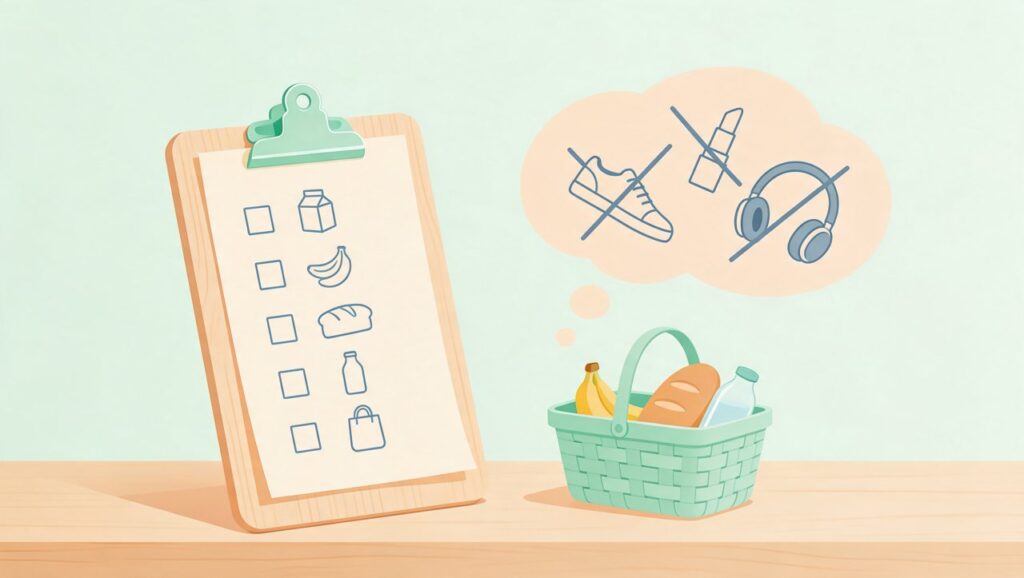
A shopping list is a filter for your own brain. When you decide what to buy before you open an app, you give yourself rules to follow. This guide shows you how to build a list that works and how to stop impulse buys before they happen, without making shopping feel like a chore.
Start with a waiting list, not a wish list
The biggest mistake people make is putting an item in the cart the second they like it. That little red notification badge on the cart icon starts to feel like a countdown. Instead of using the cart as a holding area, create a separate note on your phone or a handwritten list called “Waiting.” This is where every “maybe” item goes.
The rule is simple. If you see a pair of sneakers that looks great in a flash sale, you write them down on the Waiting list. You do not check out. You close the app. Then you give yourself a cooling off period. For most items, a week is enough. For anything over a certain amount that feels significant to you, try waiting two weeks or even a month.
What you will notice is that most of the items on that list lose their shine after a few days. The sneakers that looked incredible at midnight on a Tuesday look ordinary on a Sunday afternoon. The kitchen gadget you thought would change your cooking routine suddenly seems like another thing to store. When the waiting period is over, you will probably delete more than half of the list. The things that survive are the ones you actually want.
This works because it separates the emotional rush from the decision. Online stores are built to create urgency. Timers, low stock warnings, and special prices all push you to act now. A waiting list is your way of stepping out of that pressure. You are not saying no forever. You are just saying not yet.
Audit what you already own before you browse
It is very easy to buy duplicates when you shop online. You see a nice shade of lipstick, a phone cable, or a plain white t-shirt and you think it would be useful. But you probably already have three versions of it in a drawer. Before you add anything to your shopping list, take ten minutes to look at what you already have.
Open the drawer where you keep chargers and cables. Count them. Check the bathroom shelf for skincare products that are still half full. Look at your closet and count how many black tops you own. The goal here is not to make yourself feel guilty. It is to give yourself accurate information. A shopping list based on reality is much stronger than one based on a vague feeling that you might need something.
For example, if you are planning to buy a new pair of running shorts, check your activewear drawer first. You might find a pair you forgot about because they were buried under yoga pants. If you find two pairs that still fit, you can remove the shorts from your list or move them to the Waiting list. This small habit saves money and storage space.
A good trick is to take photos of the areas where you tend to overbuy. If you always buy mugs, take a picture of your mug cabinet. If you hoard notebooks, snap a photo of your desk drawer. Before you tap “Buy Now” on another version of the same thing, look at the photo. It will stop you more often than you expect.
Separate needs, replacements, and “fun” items
A useful shopping list has categories. When everything is lumped together, it is hard to make good decisions. Split your list into three sections: Needs, Replacements, and Fun.
Needs are things you must have to function in your daily life. This might be laundry detergent, a new water bottle because your old one cracked, or a specific gift for a birthday that is coming up. These items get priority. You can buy them without guilt when you find a decent price.
Replacements are items you are buying because something ran out or broke. You are not adding anything new to your home. You are swapping an empty bottle for a full one or a broken item for a working one. These are also safe to buy, but only if you have actually finished the old one. Do not buy a replacement serum while the current bottle still has a quarter left. Wait until it is truly done.
Fun items are everything else. A new eyeshadow palette, a decorative pillow, a phone case in a different color, a pair of earrings that just looks nice. There is nothing wrong with buying fun items. The problem is when they sneak into your cart disguised as needs. By labeling them honestly, you can decide how much of your budget should go to fun. Maybe it is ten percent of your monthly shopping money or one small item per paycheck. The label helps you see what you are really doing.
Build the list from your calendar, not from the app
Most people open Shopee or another shopping app and scroll until something catches their eye. That is backwards. The app becomes the source of ideas, and you end up wanting things you did not know existed ten minutes ago. A better approach is to build your shopping list from your actual life.
Look at your calendar for the next month or two. Do you have a beach trip coming up? You might need a waterproof phone pouch or a sun hat. Is a friend’s wedding on the horizon? Maybe you need a specific color of dress shoes or a small clutch bag. Is your lease ending soon? You might need packing tape and boxes. These are real needs that come from your schedule, not from an algorithm.
Also think about seasonal changes. If the rainy season is approaching where you live, an umbrella or a quick-dry towel might be a smart purchase. If you are heading into a hotter month, check whether your fan or air cooler still works before you need it. These are practical items that will make your life easier because you planned ahead.
When you build a list this way, every item has a reason attached to it. You are not just buying a tote bag because it was on sale. You are buying it because you are taking a weekend trip and your old bag has a broken zipper. That reason keeps you focused. It also makes it easier to ignore the thousands of other things that appear on your screen while you search.
Use the search bar with a mission
Once you have your list, change how you use the app. Do not start on the home page. The home page is a billboard designed to show you things you were not looking for. Instead, go straight to the search bar and type in the specific item from your list.
If you need a stainless steel kitchen scissors, search for exactly that. Do not browse the kitchen category. Do not tap on the banner that says “Kitchen Deals Up to 70% Off.” That banner is built to grab your attention. By going straight to search, you take control of what you see.
When the results appear, use the filters. Sort by relevance or price, depending on what matters to you. Check seller ratings and read a few reviews that mention the specific thing you care about. For a scissors, you want to know if it cuts through chicken bones or if the blades rust after washing. For a bag, you want to know if the straps are comfortable and if the zipper is smooth. Reviews that mention your specific concern are more useful than star ratings alone.
This approach turns shopping into a task with a beginning and an end. You search, you compare two or three options, you decide, you check out, you close the app. You are not being pulled into a rabbit hole of discovery. You are getting in and getting out with the thing you planned to buy.
Set a “cooling off” rule for flash sales and vouchers
Flash sales and vouchers are the biggest triggers for impulse buys. The countdown timer makes you feel like you are losing money if you do not act. A voucher with a minimum spend makes you add extra items to your cart just to hit the threshold. Both of these can push you to spend more than you planned.
Create a personal rule for these situations. For flash sales, tell yourself that you will only buy something from a flash sale if it was already on your list before you saw the sale. If it was not on your list, the discount does not matter. You are not saving fifty percent on a forty dollar item. You are spending twenty dollars on something you did not plan to buy. That is not saving. That is spending.
For vouchers, do the math before you add extra items. If you have a voucher that gives you three dollars off a thirty dollar purchase, and your cart is at twenty two dollars, you might be tempted to add an eight dollar item to reach thirty. But you are not saving three dollars. You are spending five dollars more than you originally planned, and you are bringing home an item you did not need. The only time a voucher is a true win is when your planned items already meet the minimum spend.
Check the voucher terms in the app each time, because they change often and vary by seller and campaign. Some vouchers only apply to certain categories or have a cap on the discount. Read those details before you build your cart around a voucher.
Give every fun purchase a “home” before you buy
One of the best questions you can ask before buying something decorative or extra is: where will this live? If you cannot picture the exact spot in your home where the item will go, you probably do not need it.
This works for clothes too. Before you buy a new shirt, think about what you will wear it with. If you need to buy new pants to match the shirt, that is a bigger commitment. If you already have at least two bottoms that go with it and you can name them, the shirt has a place in your wardrobe. If you are not sure, move it to the Waiting list.
For home items, the question is just as useful. A cute ceramic bowl is only a good purchase if you have a shelf or table where it will actually be used or displayed. If your shelves are already full, you are buying a storage problem. The same goes for kitchen gadgets. An air fryer is a great tool for some people, but only if you have counter space for it. If you would have to move three other appliances to use it, you will probably use it less than you think.
This rule forces you to think about your real life instead of the fantasy version of your life. The fantasy version has a clean, spacious kitchen and a closet full of perfectly coordinated outfits. The real version has a crowded drawer and a laundry pile. Shop for the real version.
Track your wins and your misses
Most people only remember the purchases they regret. They forget the times they almost bought something silly and stopped themselves. Keeping a simple note on your phone can change that. Every time you resist an impulse buy, write down what the item was and how much you did not spend. After a few weeks, you will have a list of small victories that adds up to real money.
You can also track your misses. Maybe you bought a dress on impulse and wore it once. Write down why it did not work. Was the fabric different from the photos? Did it not fit the way you hoped? Was it just not your style in real life? These notes help you spot patterns. If you keep buying clothes that look good on a model but not on you, you will learn to be more careful with sizing and fabric descriptions.
This is not about punishing yourself. It is about paying attention. Online shopping moves fast, and it is easy to repeat the same mistakes because you never stop to look at what happened. A short note like “did not need another phone case, old one is fine” or “impulse bought a ring light, used it twice” is enough to remind you next time.
Over time, these notes become a personal guide to your own shopping habits. You will start to see which categories trip you up and which ones you handle well. That awareness is worth more than any discount code.
Quick checklist before you check out
When you are about to pay, run through this list. It takes less than a minute and it can save you from a lot of bad purchases.
- Was this item on my list before I opened the app today?
- If it is a replacement, is the old one empty, broken, or truly unusable?
- Did I check what I already own to make sure this is not a duplicate?
- Do I know exactly where this will live or what I will wear it with?
- Am I buying this because I need it, or because a timer or voucher is pressuring me?
- Did I read reviews that mention the specific thing I care about?
- If this is a fun item, does it fit within my fun budget for this month?
- Would I still buy this if it was not on sale?
- Can I comfortably afford this without a pay-later option or a card balance I cannot pay off on time?
- If I wait one more week, will I still want it?
If you answer no to any of these, close the cart and step away. The item will still be there tomorrow, and if it is not, another one just like it will appear soon enough. The goal is not to stop buying things you love. It is to make sure that when you do buy, you are buying on purpose.